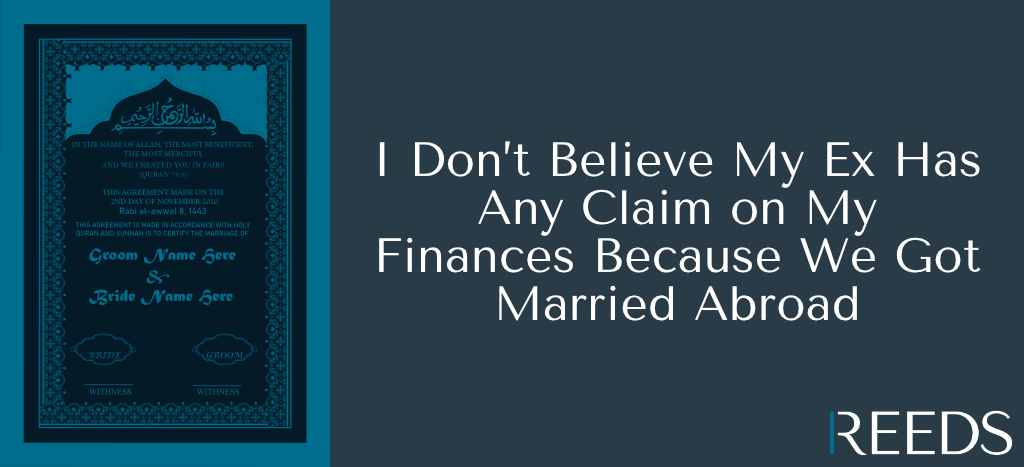
We are frequently asked is Islamic Marriage Recognised in UK? And whether this effects the status of claims an ex has during divorce. This short article explains what financial claims can arise out of your Islamic marriage if you did not register your Nikah with a civil ceremony.
When a marriage breaks down, financial obligations and rights can become a major concern for all. If your marriage was conducted abroad under Islamic law (Nikah) but was not registered through a civil ceremony in England and Wales, it is important to understand what this means for your financial position.
Is Islamic Marriage Recognised in UK?
There are a few factors to consider to determine if Islamic marriage recognised in UK. If your Islamic marriage took place abroad in a country where such marriages are legally recognised, it may be recognised in the UK provided the requirements for a legal marriage in that country were met and both parties had capacity to marry.
However, Islamic marriages conducted in the UK are not legally binding under English and Welsh law unless accompanied by a separate civil ceremony. This distinction has significant implications for your financial rights after Nikah.
What Does This Mean For You?
If you choose not to register the marriage in a civil ceremony, it is still important that you understand that you may not have the same financial rights as legally married couples in life or death. This does not, however, mean you have no financial rights. Here are some key areas to consider if you are dealing with unregistered Islamic marriage financial claims:
- Children. If you have children and are no longer living together, there will be an obligation for the non-resident parent to pay the resident parent child maintenance for the benefit of the children. Child Maintenance is a statutory obligation which applies regardless of whether the parties were legally married or not.
- Property. If you own property together, it is important check if you own the property as Joint Tenants (JT) or Tenants in Common (TiC). JT means that you own equal shares and in the event that one of you dies, the surviving party would automatically own the entire property. TiC means you each own separate and distinct shares which form a part of your estate if you were to die.
If the property is solely owned by your partner, generally you will have no automatic legal claim. You may, however, be able to establish a beneficial interest in the property if you can prove you have a financial or equitable interest in the property. This is a common issue in Islamic marriage property disputes.
- Bank accounts and debts. You will each be entitled to the funds in your own bank accounts For joint account, both parties have an equal right to the funds. Similarly, you are responsible for your own debts but joint debts creates equal liability for both parties.
- Inheritance. There may be implications to your inheritance rights. Under UK law, intestacy rules apply and Islamic inheritance principles are not automatically recognised. This can have serious implications for estate planning and financial security.
The financial implications of an unregistered Islamic marriage in the UK can be complex and often misunderstood. If you would like advice on any of the issues raised in this article, please contact Irrum Shah, Associate Solicitor in our Family Law Department by calling 0333 240 7373, or email us at [email protected].
About the Author
Irrum Shah is an Associate Solicitor Advocate specialising in family law, including divorce, finances, Shariah law, cohabitation, children matters and domestic abuse. She is known for her clear, compassionate advice and writes to make family law accessible and empowering for individuals and families.