If you have received a Notice of Proposed Driving Disqualification, it indicates that the court is considering imposing a 6-month totting ban for reaching 12 points, or that a single speeding incident is serious enough for a ban to be considered.
This notice is effectively a warning from the court that disqualification is being actively considered and that your case has reached a stage where a ban is a realistic outcome, rather than a remote possibility.
Many people receive this notice after pleading guilty to a speeding offence, commonly via a Single Justice Procedure (SJP) summons. In other cases, it follows completion of a Notice of Intended Prosecution (NIP) and the return of the s.172 driver information. At this stage, the court is no longer determining guilt, but considering the appropriate sentence.
For most people, losing their driving licence is unthinkable. It can jeopardise employment, disrupt family responsibilities and create wider personal difficulties. This is why it is important to understand what the notice means, what options are realistically available, and what the court will expect if you seek to avoid disqualification.
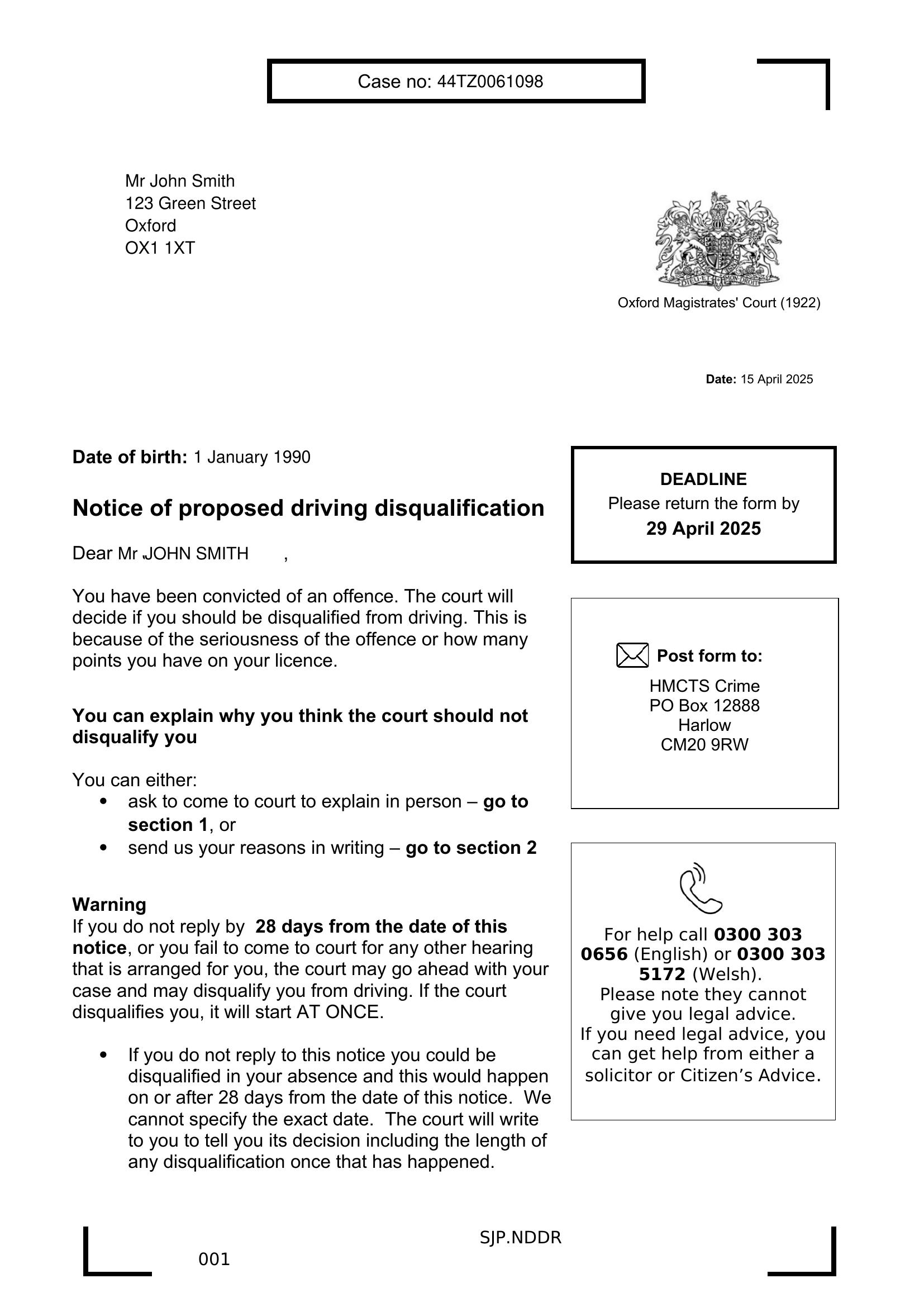
The document below shows an example of the type of notice sent by the Magistrates’ Court. The details have been fictionalised. Click to enlarge.
We are true specialists in this area and can formulate the legal arguments required to give you the best possible chance of keeping your licence.
If you have received a Notice of Proposed Driving Disqualification and would like advice, please email us at [email protected] or contact us here. Alternatively, you can phone 0333 240 7373.
What is an Exceptional Hardship Argument and when does it apply?
If the new driving matter would take you to 12 points or more on your licence, the only way to avoid the 6-month ban is to make a successful exceptional hardship application. These applications have a high threshold and require careful preparation and at times creative thinking to build a strong argument for the court. The court assesses your points as they stood on the date of the offence, not the position by the time you appear in court, even if some points have since expired.
For more information, see our exceptional hardship application page.
When can a single speeding offence lead to a driving ban?
Some speeding offences fall into a category where the court is entitled to consider an immediate ban, even if you have few or no existing points. The issue is not totting-up, but the speed itself. This typically arises where the alleged speed is significantly above the limit and outside the sentencing range for penalty points.
Where the speed is at the lower end of the disqualification range, or there are compelling circumstances, properly presented mitigation can sometimes persuade the court to impose penalty points instead of a short disqualification or reduce the disqualification to a lower level. We regularly make these arguments in court and can provide you with clear advice.
How should I respond to a Notice of Proposed Driving Disqualification?
If you want to argue against being banned, you must indicate this clearly on the paperwork accompanying the Notice of Proposed Driving Disqualification and return it to the court before the deadline. Exceptional hardship applications almost always require a full court hearing, because the magistrates will usually want to hear from the driver on oath and the prosecutor or the court must be given the opportunity to ask questions and test the account.
Even if you complete the box ‘explain in writing why you think you should not be disqualified’, the court will almost certainly list the case for a full hearing.
What happens if I ignore the Notice?
If you do not respond by the deadline, the court will proceed to sentence you in your absence. In most cases this will result in a disqualification, together with the usual penalties such as a fine, prosecution costs and a surcharge.
The notice of proposed driving disqualification makes clear that if the court disqualifies you from driving, ‘it will start at once’ – meaning the ban begins immediately, even before you receive written confirmation.
What if I have received multiple Notices?
It is not unusual to receive more than one Notice of Proposed Driving Disqualification if you have been caught speeding several times within a relatively short period, particularly as it can take up to six months for a case to be processed after returning the s.172 notice.
We can advise you on how best to manage this situation. It is crucial that all matters are sentenced together if you are at risk of a totting ban, as otherwise you may be required to make repeat exceptional hardship applications.
Why early legal advice matters
This early stage is an ideal time to seek our assistance. Exceptional hardship applications require thorough preparation; supporting documents need to be gathered, and letters often need to be drafted with care. We have an exceptionally strong track record in these applications, built on meticulous preparation and examining every angle of a client’s circumstances.
We can arrange a conference, either virtually or in person, and advise you on a clear plan of action. By the time the court date arrives, we will be fully prepared, which can significantly reduce the understandable anxiety of having to attend court.
What areas of the country do Reeds Solicitors cover?
With over 20 offices across England and Wales, Reeds Solicitors can represent you wherever you are based. We have established offices in London, Reading, Oxford, Cardiff, Manchester and Bristol, supported by a wider network of regional offices.
We can offer meetings either virtually or in person, depending on what works best for you.